

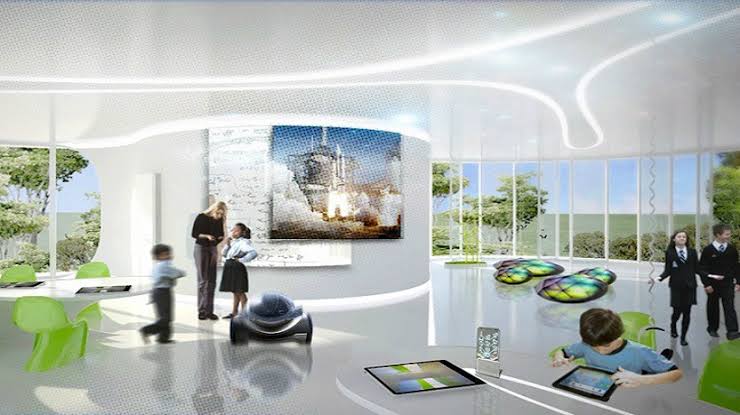
The classrooms’ layout throughout the EU are more or less similar: rows of students’ desks facing the teacher’s desk and the blackboard or interactive whiteboard. Such a layout mirrors one of the first classrooms, designed in the 19th century in the Austrian-Hungarian empire and intended for military purposes. It therefore seems that classrooms have not evolved much in the last two centuries, despite the considerable advances in pedagogy.
One of the most recent pedagogical methodologies is the Learning Community, originally developed in Spain and Portugal, which relies heavily on dialogic learning and student-centred pedagogy. The methodology is based on six “Educational Actions for Success” which in turn were inspired by Lev Vygotsky’s Social Learning Theory and the Zone of Proximal Development. More recently, Howard Gardner developed the Multiple Intelligences Theory, which suggests eight types of intelligences in human mind, far more than the ones that are typically developed at school, based on numbers and words.
So the first motivation for the project is to design and produce an innovative classroom that takes into consideration such theories, the same way Montessori’s classrooms mirror the pedagogy behind them.
The second motivational aspect is to create classrooms that are environmentally friendly, i.e. made with sustainable or recycled materials, as most of nowadays’ desks and chairs are made of plastic. The considerable number of chorus students spend at school, mostly sitting on chairs, makes it absolutely relevant to take into account ergonomic issues to ensure the right posture during the educational activities.
Also, as the three partner organisations work with students with fewer opportunities, the partnership wanted on the one hand to make cutting-edge STEM technology (3D design and printing, laser cutting and WordPress web design) available for those students and on the other hand give them the chance to transform their educational environment according to their own needs, thus fostering empowerment, self-confidence and self-esteem.
The fourth motivation is to build innovative methodologies based on the STEM approach, the pedagogical theories mentioned above and a hands-on focus, with the aim to maximise students’ engagement by placing them at the centre of their learning process.
Finally, the three VET schools aim to build a project with a strong entrepreneurial perspective, in collaboration with real companies, that boosts proactiveness, resilience, creativity and collaboration in a real-world scenario.